Skip to content
ikIbi Kontein

Research

The commitments are not hard to find. Nigeria has national action plans, ratified conventions, ministerial statements and two decades of declarations about protecting women in conflict. What is hard to find is anyone checking whether they hold. That is the work: reading what the state says, tracing it into policy, and testing it against what women in the northeast actually experience. Related strands include gender and security, political legitimacy, post-conflict governance, and democracy and authoritarian influence in Africa.

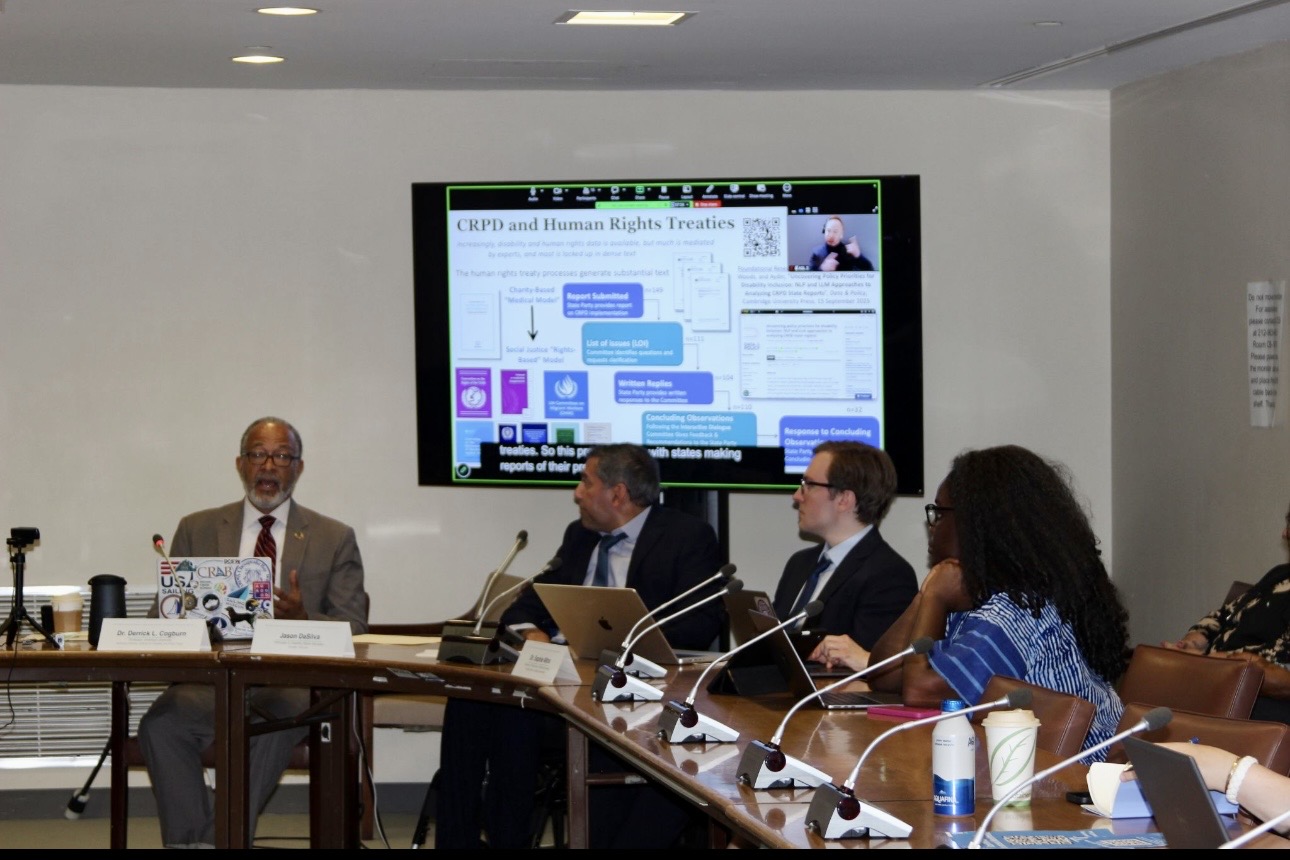
Conference panel discussion on the Convention on the Rights of Persons with Disabilities
CRPD and human rights treaties panel

Current research

Performing Protection: State Gender Rhetoric and Women's Rights in Nigeria

Conference paper

American Political Science Association Annual Meeting, Boston, September 2026

Nigeria says a great deal about protecting women, and says different things depending on who is listening. This paper analyses the state's own protection rhetoric across the Chibok and Dapchi abductions, using a corpus of twenty-five texts spanning international, domestic and policy registers under two administrations. It finds the rhetoric is audience-segmented: the register offered to donors and treaty bodies differs systematically from the one offered at home. It then tests that rhetoric against a panel of security, education and displacement outcomes for Borno, Adamawa and Yobe, where the numbers barely move. The argument is protection without audit: commitments are produced constantly and verified almost never.

Global Autocratization in Africa

Work in progress, with Carl LeVan

A co-authored study of Russian foreign authoritarian influence and democratic attitudes in sub-Saharan Africa, with Carl LeVan. Using the Russian Authoritarian Influence dataset alongside Afrobarometer, we examine whether sustained exposure to authoritarian influence tracks with erosion in citizens' commitment to democracy. We distinguish two mechanisms: illiberal socialization, where chronic exposure gradually shifts attitudes, as in Mozambique and Cameroon, and autocratic priming, where episodic influence produces sharper movement, as in Senegal. Ghana serves as the low-exposure comparison. My sections cover the Mozambique and Cameroon cases and the analysis in R.

Previous research

United Nations Security Council Resolution 1325 and the Security of Women in Nigeria's Boko Haram Conflict (2009 to 2023)

MSc dissertation

Commendation for dissertation excellence

Methods

  • Quantitative analysis
  • Survey research
  • Qualitative coding
  • Policy document analysis
  • Archival research
  • Text analysis
  • Discourse analysis
  • Mixed methods

Upcoming

  • Performing Protection: State Gender Rhetoric and Women's Rights in Nigeria

    American Political Science Association Annual Meeting · Boston · September 2026

  • Global Autocratization in Africa

    African Studies Association Annual Meeting · New Orleans · December 2026

  • Global Autocratization in Africa

    International Studies Association Annual Convention · Atlanta · March 2027